Author Archives: Disciple of Christ, Wife, Mommy of 5 blessings & business owner.
A WARNING TO THE CHURCH!
A warning to the Church!!!! Take heed and turn to the Lord. Watch the video below and share with your friends!
User-friendly Christianity.

User-friendly Christianity is now widely promoted as the best way to grow a church.
Yet jesus never made an effort to go to any church-growth seminars. He didn’t seem worried about attracting crowds. Pity, too. He could have avoided a lot of problems in ministry.
Consider this incident in John 6:60-71. He had just fed the 5000, then claimed He was “the bread of life.” Next, He told people no one could come to Him unless the Father draw s him or enables him.
“This is a hard teaching,” many of the disciples protested. “Who can accept it? (verse 60).
“Does this offend you?” Jesus asked. “There are some of you who do not believe” (verse 61,64).
Now that is no way to treat rye unchurched. These sincere “seekers” needed a chance to reexamine His claims in light go their own experience.
This was no time to get tough with them. Didn’t He want a large following?
Think of the impression that would have made on the boys in Jerusalem.
Jesus, however, was completely disinterested in such tactics.
In fact, He drove these men away! “Many of His disciples turned back,” the Bible says, “and no longer followed Him” (verse 66.)
Then Jesus had the audacity to ask the Twelve if they wanted to leave as well. Didn’t He understand anything about attracting and holding crowds?
“Go ahead and leave!” He might as well have said.
But the twelve knew better. Thyat’s why they were the twelve. And yet, even one of them wasn’t for real!
“Lord, to whom shall we go?” Peter asked on their behalf. “You have the words of eternal life. We believe that you are the Holy One of God” (verses 68-69).
The fact is, Jesus had His own style of church growth.
It was addition by subtraction, on thinning out the ranks. If you’re not sure, leave!
He never begged anyone to follow Him. He called. He commanded. He demanded. But He never begged.
If you think you have a better option, then go ahead and try it. But you won’t find anything better or more satisfying than real christianity. It works because it’s genuine. It truly does transform the heart and regenerate the soul. Nothing can compare to it.
Personal relationship with Christ is not the same as void religion. Religion has its set of rules you must adhere to in order to be pleasing in the sight of God. Relationship fulfilled the rules in order that we may have life and have it abundantly. In turn, we obey the command He summed up in “Love your God with all your heart, soul and mind and your neighbor as yourself” because we love Him. And we love Him because He first loved us while we were sinners…Christ died for US!!!
Portion taken from No Greater Savior.
Is He Lord of your Life?
There is no question about who Jesus is. The Bible makes it clear. The apostles made it clear. And Jesus Himself makes it clear. He is Lord!
The only real question that remains, then, is this: Is HE Lord of your life?
This about the answer.
Remember Lordship implies ownership. Does He own your tongue and what you say? Does He own your eyes and what they see? Does he own your hand and what they touch?
You don’t have to be perfect to have Him as your Lord. The disciples to whom He said, “You call me.. ‘Lord’ and rightly so” (John 13:13) were far from perfect. In fact, they would deny and forsake Him the very next day!
Jesus’ lordship is not conditioned upon our obedience. He is still Lord even when we fail Him. We can sin against His Lordship, but we can’t sin away His lordship. Once we belong to Him, He cannot love us more. And He will not loves us less than He already loves us. His love is perfect and constant.
The bible calls upon us to trust Christ with our lives and our eternal destiny. It makes no distinction between receiving Him as Savior and Lord. He is both and He is to be received as both. You don’t get half of Jesus at one point in your life and wait to receive rye other half at a later time.
When you bowed your heart and soul and entrusted your life to Him, you received ALL of Him – Savior and Lord. And He received all of you – your total person.
Once you belong to Him, Jesus calls upon you to obey Him. It won’t make Him any more your Lord than it will make Him any more your Savior. But it will determine the level of your commitment and the extent of your impact for the cause of Christ and the Kingdom.
How committed are you? Are you allowing Jesus to exercise Lordship over your life? His plan for you is much better than anything you could ever dream of. In order to become everything He created you to be, you must surrender to His lordship in your life.
We miss so much when we try to live on our own terms and our own agenda.
Portion of No Greater Savior Devotional.
Genealogy of the KING! Matthew 1:1-17
Brief History…
At the time Christ was born, the Roman empire was in control over Israel. There were two types of taxes imposed on the Jewish people. A tax on your income and on your property. Rome was very systematic and unforgiving when it came to taxing the people of Israel. Tax collectors or publicans were viewed in the same way prostitutes and murderers were viewed. They gathered mercilessly from their own country men to give to wealthy Rome. They were traitors in the people’s minds.
Purpose…
Matthew is one of the most clear books in terms of authorship. All early manuscripts have Matthews name attached to it. Unanimously asserting Matthew’s (Levi’s) authorship.
One of the reasons we see the genealogy of Christ at the beginning of Matthew is because he is giving scriptural proofs of the Messiahship of Jesus. Matthew takes Jesus’ lineage all the way back to the nation’s inception in the Abrahamic Covenant. (See below for a detailed explanation of the Abrahamic Covenant.)
It concentrates on linking Jesus to King David, whose ‘son’ the Messiah was to be, & fits Him into the development of God’s purpose of salvation in the OT. The genealogy shows Christ’s right to reign as King of Israel. The genealogy places Jesus fully in line with the history of OT Israel. By organizing that history into a regular scheme of three groups of fourteen generations, it indicates that the time of preparation is now complete and that in Jesus the time of fulfillment has arrived.
Themes/ Outline…
~ Traces Jesus descent through the royal line of Judah, it stakes His claim to the title “King of the Jews”.
~ It establishes His status as “Son of David”, not only by emphasizing David’s place in the genealogy but by showing that Jesus is a legitimate heir to the throne by pedigree.
It is highly unusual for women to be mentioned in genealogies (there are at least 50 genealogies in the OT).
Matthew names five:
~ Tamar: canaanite woman who posed as a prostitute to seduce Judah (Gen 38:13-30)
~ Rahab: a gentile & prostitute (Jos 2:1)
~ Ruth: moabite woman & worshiper or idols (Ruth 1:3)
~ Bathsheba: wife of Uriah, committed adultery with David (2 Samuel 11)
~ Mary: bore the stigma of pregnancy outside of marriage
All of these women are mentioned, most possibly as a testimony of God’s divine grace!
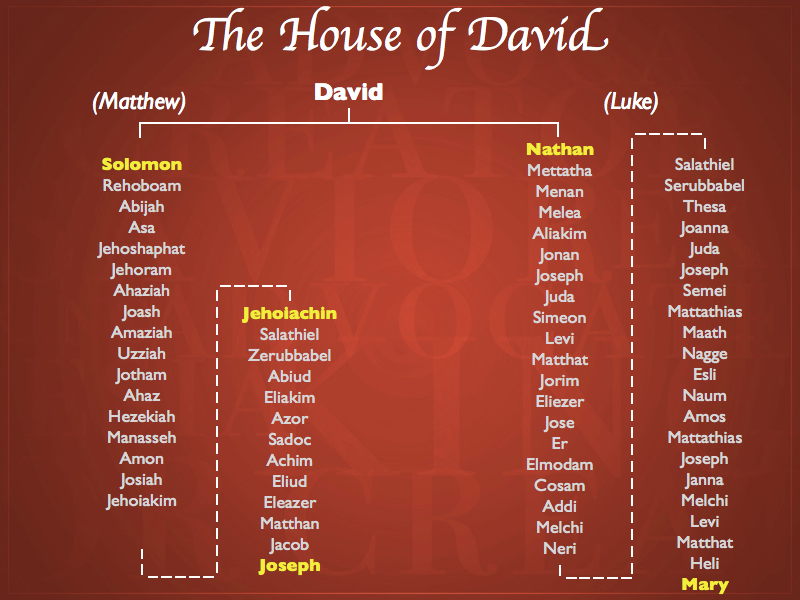
The difference between Matthew’s and Luke’s genealogy is that Luke records the actual physical genealogy of Joseph (the legal line) by way of ascention…starting with Jesus. Matthew’s genealogy is descending from Abraham to Jesus, recording the line of succession to the throne. The royal line. This genealogy establishes Jesus as Joseph’s legal heir.
~ Matthew shows the royal line.
~Luke shows the blood line.
The royal line could only come from the father. Since Joseph was not Jesus’ earthly father, his blood line (from Mary) had to be directly linked to the seed of David to be able to claim the throne. Through Joseph He gets the claim to the throne and through Mary he gets the claim of being from the blood of David.
David had two sons; Solomon & Nathan.
Joseph is a descendant of Solomon while Mary is a descendant of Nathan. Both from the tribe of Judah, both from the house of David. Making Christ the only ligitament heir to the throne of David.
Pedigree was of the utmost importance to the Jews. If anybody was going to claim to be King, they must prove it by way of pedigree.
After the conquest of caanan (the land flowing with milk and honey), it was essential to determine what your tribe/heritage was so that you knew where you were to live because the land was divided into sections for each tribe.
Example: in Numbers 26 &35 – you had to know your tribe, heritage and location of your father’s house so that you could identify the right section of land for you to live. Tribal identification was essential.
Also, in Ezra 2:62 – After the Babylonian captivity, when the Jews started coming back to Israel, some were claiming to be priests (the tribe of Levi). A pedigree was essential to prove where they came from. If this did not show them as descendants from the tribe of Levi they were removed from priesthood.
In Romans 11:1 Paul lays out his pedigree.
I say then, God has not rejected His people, has He? May it never be! For I too am an Israelite, a descendant of Abraham, of the tribe of Benjamin.
Today there isn’t a Jew in the world that can prove by pedigree what tribe they are from. All this information has been lost. Jesus Christ was the last verifiable claimant to the throne of David.
This is not an exhaustive genealogy. Several additional generations must have elapsed between Rahab (Joshua’s time) & David…nearly 400 years later. It is speculated this was done in order to abbreviate the listing.
Abrahamic Covenant
A covenant is an agreement between two parties. There are two types of covenants: conditional and unconditional. A conditional or bilateral covenant is an agreement that is binding on both parties for its fulfillment. Both parties agree to fulfill certain conditions. If either party fails to meet their responsibilities, the covenant is broken and neither party has to fulfill the expectations of the covenant. An unconditional or unilateral covenant is an agreement between two parties, but only one of the two parties has to do something. Nothing is required of the other party.
The Abrahamic Covenant is an unconditional covenant. God made promises to Abraham that required nothing of Abraham. Genesis 15:18-21 describes a part of the Abrahamic Covenant, specifically dealing with the dimensions of the land God promised to Abraham and his descendants.
The actual Abrahamic Covenant is found in Genesis 12:1-3. The ceremony recorded in Genesis 15 indicates the unconditional nature of the covenant. The only time that both parties of a covenant would pass between the pieces of animals (animal sacrifices) was when the fulfillment of the covenant was dependent upon both parties keeping commitments. Concerning the significance of God alone moving between the halves of the animals, it is to be noted that it is a smoking furnace and a flaming torch, representing God, not Abraham, which passed between the pieces. Such an act, it would seem, should be shared by both parties, but in this case it is doubtless explained by the fact that the covenant is principally a promise by God. He is the one who binds Himself. God caused a sleep to fall upon Abraham so that he would not be able to pass between the two halves of the animals. Fulfillment of the covenant fell to God alone.
God determined to call out a special people for Himself through whom He would bring blessing to all the nations. The Abrahamic Covenant is paramount to a proper understanding of the kingdom concept and is foundational to Old Testament theology. (1) The Abrahamic Covenant is described in Genesis 12:1–3 and is an unconditional covenant. There are no conditions attached to it (no “if” clauses, suggesting its fulfillment is dependent on man). (2) It is also a literal covenant in which the promises should be understood literally. The land that is promised should be understood in its literal or normal interpretation—it is not a figure of heaven. (3) It is also an everlasting covenant; the promises that God made to Israel are eternal.
There are three main features to the Abrahamic Covenant:
1. The promise of land (Genesis 12:1). God called Abraham from Ur of the Chaldeans to a land that He would give him (Genesis 12:1). This promise is reiterated in Genesis 13:14–18 where it is confirmed by a shoe covenant (a binding agreement see Ruth 4:7); its dimensions are given in Genesis 15:18–21 (precluding any notion of this being fulfilled in heaven). The land aspect of the Abrahamic Covenant is also expanded in Deuteronomy 30:1–10, which is the Palestinian Covenant.
2. The promise of descendants (Genesis 12:2). God promised Abraham that He would make a great nation out of him. Abraham, who was 75 years old and childless (Genesis 12:4), was promised many descendants. This promise is amplified in Genesis 17:6 where God promised that nations and kings would descend from the aged patriarch. This promise (which is expanded in the Davidic Covenant of 2 Samuel 7:12–16) would eventuate in the Davidic throne with Messiah’s kingdom rule over the Hebrew people.
3. The promise of blessing and redemption (Genesis 12:3). God promised to bless Abraham and the families of the earth through him. This promise is amplified in the New Covenant (Jeremiah 31:31–34; cf. Hebrews 8:6–13) and has to do with “Israel’s spiritual blessing and redemption.” Jeremiah 31:34 anticipates the forgiveness of sin. The unconditional and eternal nature of the covenant is seen in that the covenant is reaffirmed to Isaac (Genesis 21:12; 26:3–4). The “I will” promises suggest the unconditional aspect of the covenant. The covenant is further confirmed to Jacob (Genesis 28:14–15). It is noteworthy that God reaffirmed these promises amidst the sins of the patriarchs, which further emphasizes the unconditional nature of the Abrahamic Covenant.
God’s method of fulfilling the Abrahamic Covenant is literal, inasmuch as God partially fulfilled the covenant in history: God blessed Abraham by giving him the land (Genesis 13:14–17); God blessed him spiritually (Genesis 13:8, 18; 14:22, 23; 21:22); God gave him numerous descendants (Genesis 22:17; 49:3–28). The important element of the Abrahamic Covenant, however, demands a future fulfillment with Messiah’s kingdom rule:
(1) Israel as a nation will possess the land in the future. Numerous Old Testament passages anticipate the future blessing of Israel and her possession of the land as promised to Abraham. Ezekiel envisions a future day when Israel is restored to the land (Ezekiel 20:33–37, 40–42; 36:1–37:28).
(2) Israel as a nation will be converted, forgiven, and restored (Romans 11:25–27).
(3) Israel will repent and receive the forgiveness of God in the future (Zechariah 12:10–14). The Abrahamic Covenant finds its ultimate fulfillment in connection with the return of Messiah to rescue and bless His people Israel. It is through the nation Israel that God promised in Genesis 12:1–3 to bless the nations of the world. That ultimate blessing will issue in the forgiveness of sins and Messiah’s glorious kingdom reign on earth.
From: Gotquestions.org
Intro to the book of Matthew.
The Gospel of Matthew deals at length with matters of the law, tradition, the fulfillment of the Jewish scriptures, and of Jesus’ confrontations with the Jewish leaders of his day. The reason many scholars believe Matthew is the first book of the New Testament is because it offers an incredible transition from the Old Testament to the New Testament; old covenant to new. The constant references to the OT and Jesus’ conflict with the Jewish authorities serves as a “bridge” between both testaments.
Some of the themes we will see in Matthew:
* Jesus as the fulfillment of the messianic OT prophecies.
* How He applies OT text to various aspects of His ministry.
* How He viewed OT law & traditions of Jewish scribal teachings.
* His conflict with official Jewish religious representatives & the nation of Israel.
* The nature of the Christian church as an extension of Judaism (after all Jesus was a Jew!)
In the gospel of Matthew we will see for the first time how salvation was extended to the gentiles. In the OT salvation was only for the house of Israel. If a gentile wanted to worship the one true God, they had to go through a number of steps according to Jewish law first (they had to be circumsized, baptized, etc.).
Time period.
Most modern scholars conclude that Matthew was written within the last 20 years of the first century (around A.D. 80, some say as early as A.D. 50) and confirmed by the writings of Eusebius ( ca. A.D. 265-339) who quotes Origen (ca. A.D. 185-254).
These are the reasons why Matthew is not dated earlier by most scholars.
1- If, as generally supposed Mark’s gospel was not written earlier than about AD 65, and Matthew used Mark, then it must have written after AD 65.
2- The destruction of Jerusalem in AD 70 is believed to have influenced such passages as Matt 22:7, 23:38 and several parts of chapter 24.
3- The “anti-Jewish” tones suit the period around AD 85 because at this time Christians were excluded from synagogue worship since a “curse” against Nazarenes and heretics was added to the synagogue’s laws on worship ( AKA Liturgy ). Before this time the lines were not drawn as clearly on the subject.
**I must add that this date is not conclusive. Scholars form all walks of life still debate the dating of Matthew. No one knows the exact date, we just have an approximation.
The writer.
Early Christian theologians unanimously believe this gospel was written by the disciple Matthew (The tax collector). Whose call can be found in Matt 9:9.
From the characteristics of the gospel we can assume that Matthew was a Jewish-Christian with a strong interest and extensive knowledge in the OT. He was very familiar with the traditions of the scribes and with the methods of Rabbinic debate. Matthew was capable of writing in Greek even though he was clearly Semitic ( relating to people who speak Aramaic, Hebrew or Arabic).
As I mentioned before Matthew was a tax collector whose former name was Levi. A tax collector back in those days had to be fluent in Greek as a job requirement. The name Levi as a general consensus was more of a tribal name, denoting he was from the tribe of Levi. In which case he was right at home with scribal tradition. This book was written to strengthen the faith of Jewish Christians and as a useful apologetics tool for Jewish evangelism. Matthew was written mainly to a Jewish audience.
Central Theological Emphases of Matthew.
Fulfilment
* The fact that Jesus was the fulfillment of all OT prophesies as the much awaited Messiah as well as the fulfillment of the Law (The Old Covenant was done away with and a New Covenant started).
Christology (the study of the attributes of Christ)
* The major theme in Matthew is the explanation of who Christ is.
1- Christ as Messiah ( the word Messiah is Christ in Greek).
2- Christ as the Son of man ( Christ as a human being).
3- Christ as King. Jesus fulfills the institution of kingship in the OT, he is the “son of David”, the “greater than Solomon”. Matthew’s genealogy of Jesus focuses on his royal descent from Israel’s greatest King, David.
4- Christ as the Son of God. This is revealed to us not as much from Christ himself in this gospel as from God Himself, what others call Him, by Satan, demons and eventually by his disciples as they begin to get a deeper knowledge of who He is.
* The law. In this book you will see Jesus’ relation to the law. If He was the fulfillment of it, we must understand His relation to it especially when the Jewish people prided themselves in being the people whom God gave His laws to. The law was the entire focus of their life and religion. It was out of such concern for the law that the scribes developed a complex set of rules on how to live a correct life and worship which is called the Mishna. The scribes and pharisees were known for keeping the Mishna meticulously.
* The people of God.
1- The failure of Israel to repent and recognize their Messiah as John the Baptist calls them to repent.
2- The nature of the new community. Christ didn’t require membership of the nation of Israel but repentance for their sins. Those who responded to the call of repentance and faith became member of a new community of the forgiven. Membership of the people of God was not a matter of belonging to the right nation or ethnic group. Now it was composed of those who had heard and responded to the message of Christ and established a proper relationship with Him.
The structure of the gospel of Matthew (main section divisions).
* Three groups of fourteen generations ( 1:1-17)
* Three temptations with quotations in reply ( 4:1-11)
* Eight beatitudes ( 5:3-10)
* Six “antithesis” ( 5:21-47)
* Three types of religious observance (6:1-6, 16-18)
* Three symbolic actions (21:1-22)
* Three polemical parables (21:28 – 22:14)
* Seven woes on scribes and pharisees ( 23:13-36)
* Three prayers & return to sleeping disciples ( 26: 36-46)
* Three denials by Peter (26:69-75)
By topic this book can be divided as follows:
Intro – Matt 1:1 – 4:11
Ministry in Galilee – Matt 4:12 – 13:58
Wider ministry in the North – Matt 14:1 – 16:12
Towards Jerusalem – Matt 16:13 – 20:34
Confrontation in Jerusalem – Matt 21:1 – 25:46
Passion and Resurrection – Matt 26:1 – 28:20
There are five major discourses in this book.
The Sermon on the mount (chaps 5-7).
The Commissioning of the Apostles (chap 10).
The Parables about the Kingdom (chap 13).
Discourse about the Christ-likeness of the believer ( chap 18).
The Second Coming ( chaps. 24 & 25).
The exegetical Issue with Matthew.
On Jesus’ Olivet discourse, the prophetic passages present an interpretative challenge. In this discourse Jesus gives some details of the violent destruction of Jerusalem in A.D. 70. His words in chapter 24:34 have led some to conclude that all these things He was speaking of were already fulfilled (although not literally) during the conquest of the Romans in that era. This view is called Preterism. This interpretation if flawed because it forced the reader to read into the passage spiritualized and allegorical meanings that are commonly not used in normal exegetical methods.
When interpreting Matthew the grammatical- historical hermeneutics approach to these passages is what should be followed. This method yields consistent, futuristic interpretation of yet to be fulfilled end time prophesy.
Note:
-
Hermeneutics: [Greek, hermeneutilos, from hermeneus =an interpreter (from Hermes)]. Applied to the study of Scripture: The art and science of Biblical interpretation. The “science” involves study of the ancient languages and the individual words in which a Biblical passage is written. The art involves unfolding the significance of a passage by discerning what the inspired writer meant to convey to the reader, taking into consideration the historical period, the culture of the times, and information within the entire context of the text.
-
Exegesis: [Greek, exegeomai, = ex “to explain”, or “to take from”; and hegeomai, “to lead”, “to guide”]. Applied to the study of Scripture: Taking from the Biblical text the information upon which to base an interpretation. Exegete: One who interprets a Biblical passage or text.
I pray you have come away with a much deeper understanding of what you will be studying these coming weeks in the gospel of Matthew! 🙂
Love,
Laire
A series all our 13 year olds will listen to…every teen should be required to!
 Chip Ingram ( one of my favorite parenting teachers) series on Love, Sex and Lasting Relationships. What it looks like from a biblical standpoint and what hollywood’s message is today. The difference between LOVE & INFATUATION. If you have a pre-teen/ teen this is a MUST!
These are the first two videos of the entire series. You can listen to the entire series on Chip’s site below. 🙂
Living on the Edge by Chip Ingram.
Westminster Catechism for Kids. It’s never too early to teach them Theology!
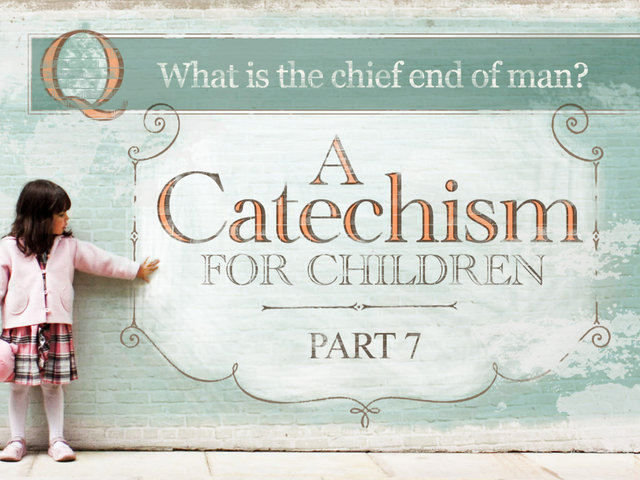 While listening to one of my favorite Bible teachers, Dr. Voddie Baucham, I came across the Westminster Catechism. It is a series of questions and answers to teach children/teens theology. This is the catechism he uses with his children and decided to start with our 3 oldest. My two toddlers (2.5 and 3.5 years old) know the first 15 question, memorized in 2 days. 🙂 We are using the regular Catechism for my oldest (10) so his answers are a bit longer. There is no such thing as too young to start learning theology and if you are inetersted in starting with your little ones I have posted all the questions and answers below. I suggest starting with 2-3 questions at a time and evaluate how long it takes them to learn them. Every child learns differently. I also created a big poster with the first 50 to work on them every day and hung it on our living room wall. They get stickers when they answer the question without help. 🙂 Make it fun for them
Q. 1. Who made you? A. God.
Q. 2. What else did God make? A. God made all things.
Q. 3. Why did God make you and all things ? A. For his own glory.
Q. 4. How can you glorify God? A. By loving him and doing what he commands.
Q. 5. Why ought you to glorify God? A. Because he made me and takes care of me.
Q. 6. Are there more gods than one? A. There is only one God.
Q. 7. In how many persons does this one God exist? A. In three persons.
Q. 8. What are they? A. The Father, the Son, and the Holy Ghost.
Q. 9. What is God? A. God is a Spirit, and has not a body like men.
Q. 10. Where is God? A. God is everywhere.
Q. 11. Can you see God? A. No; I cannot see God, but he always sees me.
Q. 12. Does God know all things? A. Yes; nothing can be hid from God.
Q. 13. Can God do all things? A. Yes; God can do all his holy will.
Q. 14. Where do you learn how to love and obey God? A. In the Bible alone.
Q. 15. Who wrote the Bible? A. Holy men who were taught by the Holy Spirit.
Q. 16. Who were our first parents? A. Adam and Eve.
Q. 17. Of what were our first parents made? A. God made the body of Adam out of the ground, and formed Eve from the body of Adam.
Q. 18. What did God give Adam and Eve besides bodies? A. He gave them souls that could never die.
Q. 19. Have you a soul as well as a body? A. Yes; I have a soul that can never die.
Q. 20. How do you know that you have a soul? A. Because the Bible tells me so.
Q. 21. In what condition did God make Adam and Eve? A. He made them holy and happy.
Q. 22. What is a covenant? A. An agreement between two or more persons.
Q. 23. What covenant did God make with Adam? A. The covenant of works.
Q. 24. What was Adam bound to do by the covenant of works? A. To obey God perfectly.
Q. 25. What did God promise in the covenant of works? A. To reward Adam with life if he obeyed him.
Q. 26. What did God threaten in the covenant of works? A. To punish Adam with death if he disobeyed.
Q. 27. Did Adam keep the covenant of works? A. No; he sinned against God.
Q. 28. What is Sin? A. Sin is any want of conformity unto, or transgression of the law of God.
Q. 29. What is meant by want of conformity? A. Not being or doing what God requires.
Q. 30. What is meant by transgression? A. Doing what God forbids.
Q. 31. What was the sin of our first parents? A. Eating the forbidden fruit.
Q. 32. Who tempted them to this sin? A. The devil tempted Eve, and she gave the fruit to Adam.
Q. 33. What befell our first parents when they had sinned? A. Instead of being holy and happy, they became sinful and miserable.
Q. 34. Did Adam act for himself alone in the covenant of works? A. No; he represented all his posterity.
Q. 35. What effect had the sin of Adam on all mankind? A. All mankind are born in a state of sin and misery.
Q. 36. What is that sinful nature which we inherit from Adam called? A. Original sin.
Q. 37. What does every sin deserve? A. The wrath and curse of God.
Q. 38. Can any one go to heaven with this sinful nature? A. No; our hearts must be changed before we can be fit for heaven.
Q. 39. What is a change of heart called? A. Regeneration.
Q. 40. Who can change a sinner’s heart? A. The Holy Spirit alone.
Q. 41. Can any one be saved through the covenant of works? A. None can be saved through the covenant of works.
Q. 42. Why can none be saved through the covenant of works? A. Because all have broken it, and are condemned by it
Q. 43. With whom did God the Father make the covenant of grace? A. With Christ, his eternal Son.
Q. 44. Whom did Christ represent in the covenant of grace? A. His elect people.
Q. 45. What did Christ undertake in the covenant of grace? A. To keep the whole law for his people, and to suffer the punishment due to their sins.
Q. 46. Did our Lord Jesus Christ ever commit the least sin? A. No; he was holy, harmless, and undefiled.
Q. 47. How could the Son of God suffer? A. Christ, the Son of God, became man that he might obey and suffer in our nature.
Q. 48. What is meant by the Atonement? A. Christ’s satisfying divine justice, by his sufferings and death, in the place of sinners.
Q. 49. What did God the Father undertake in the covenant of grace? A. To justify and sanctify those for whom Christ should die.
Q. 50. What is justification? A. It is God’s forgiving sinners, and treating them as if they had never sinned.
Q. 51. What is sanctification? A. It is God’s making sinners holy in heart and conduct.
Q. 52. For whom did Christ obey and suffer? A. For those whom the Father had given him.
Q. 53. What kind of life did Christ live on earth? A. A life of poverty and suffering.
Q. 54. What kind of death did Christ die? A. The painful and shameful death of the cross.
Q. 55. Who will be saved? A. Only those who repent of sin, believe in Christ, and lead holy lives.
Q. 56. What is it to repent? A. To be sorry for sin, and to hate and forsake it because it is displeasing to God.
Q. 57. What is it to believe or have faith in Christ? A. To trust in Christ alone for salvation.
Q. 58. Can you repent and believe in Christ by your own power? A. No; I can do nothing good without the help of God’s Holy Spirit.
Q. 59. How can you get the help of the Holy Spirit? A. God has told us that we must pray to him for the Holy Spirit.
Q. 60. How long ago is it since Christ died? A. More than nineteen hundred years.
Q. 61. How were pious persons saved before the coming of Christ? A. By believing in a Savior to come.
Q. 62. How did they show their faith? A. By offering sacrifices on God’s altar.
Q. 63. What did these sacrifices represent? A. Christ, the Lamb of God, who was to die for sinners.
Q. 64. What offices has Christ? A. Christ has three offices.
Q. 65. What are they? A. The offices of a prophet, of a priest, and of a king.
Q. 66. How is Christ a prophet? A. Because he teaches us the will of God.
Q. 67. How is Christ a priest? A. Because he died for our sins and pleads with God for us.
Q. 68. How is Christ a king? A. Because he rules over us and defends us.
Q. 69. Why do you need Christ as a prophet? A. Because I am ignorant.
Q. 70. Why do you need Christ as a priest? A. Because I am guilty.
Q. 71. Why do you need Christ as a king? A. Because I am weak and helpless.
Q. 72. How many commandments did God give on Mount Sinai? A. Ten commandments.
Q. 73. What are the ten commandments sometimes called? A. The Decalogue.
Q. 74. What do the first four commandments teach? A. Our duty to God.
Q. 75. What do the last six commandments teach? A. Our duty to our fellow men.
Q. 76. What is the sum of the ten commandments? A. To love God with all my heart, and my neighbor as myself.
Q. 77. Who is your neighbor?A. All my fellow men are my neighbors.
Q. 78. Is God pleased with those who love and obey him? A. Yes; he says, “I love them that love me.”
Q. 79. Is God displeased with those who do not love and obey him? A. Yes; “God is angry with the wicked every day.”
Q. 80. What is the first commandment? A. The first commandment is, Thou shalt have no other gods before me.
Q. 81. What does the first commandment teach us? A. To worship God alone.
Q. 82. What is the second commandment? A. The second commandment is, Thou shalt not make unto thee any graven image, or any likeness of any things that is in heaven above, or that is in the earth beneath, or that is in the water under the earth; thou shalt not bow down thyself to them, nor serve them: for I, the Lord thy God, am a jealous God, visiting the iniquity of the fathers upon the children unto the third and fourth generation of them that hate me; and showing mercy unto thousands of them that love me, and keep my commandments.
Q. 83. What does the second commandment teach us? A. To worship God in a proper manner, and to avoid idolatry.
Q. 84. What is the third commandment? A. The third commandment is, Thou shalt not take the name of the Lord thy God in vain: for the Lord will not hold him guiltless that taketh his name in vain.
Q. 85. What does the third commandment teach me? A. To reverence God’s name, word, and works.
Q. 86. What is the fourth commandment? A. The fourth commandment is, Remember the Sabbath day to keep it holy. Six days shalt thou labor, and do all thy work, but the seventh day is the Sabbath of the Lord thy God; in it thou shalt not do any work, thou, nor thy son, nor thy daughter, nor thy manservant, nor thy maidservant, nor thy cattle, nor thy stranger that is within thy gates: for in six days the Lord made heaven and earth, the sea, and all that in them is, and rested the seventh day; wherefore the Lord blessed the Sabbath Day, and hallowed it.
Q. 87. What does the fourth commandment teach us? A. To keep the Sabbath holy.
Q. 88. What day of the week is the Christian Sabbath? A. The first day of the week, called the Lord’s day.
Q. 89. Why is it called the Lord’s day? A. Because on that day Christ rose from the dead.
Q. 90. How should the Sabbath be spent? A. In prayer and praise, in hearing and reading God’s Word, and in doing good to our fellow men.
Q. 91. What is the fifth commandment? A. The fifth commandment is, Honor thy father and thy mother, that thy days may be long upon the land which the Lord thy God giveth thee.
Q. 92. What does the fifth commandment teach me? A. To love and obey our parents and teachers.
Q. 93. What is the sixth commandment? A. The sixth commandment is, Thou shalt not kill.
Q. 94. What does the sixth commandment teach us? A. To avoid angry passions.
Q. 95. What is the seventh commandment? A. The seventh commandment is, Thou shalt not commit adultery.
Q. 96. What does the seventh commandment teach us? A. To be pure in heart, language, and conduct.
Q. 97. What is the eighth commandment? A. The eighth commandment is, Thou shalt not steal.
Q. 98. What does the eighth commandment teach us? A. To be honest and industrious.
Q. 99. What is the ninth commandment? A. The ninth commandment is, Thou shalt not bear false witness against thy neighbor.
Q. 100. What does the ninth commandment teach us? A. To tell the truth.
Q. 101. What is the tenth commandment? A. The tenth commandment is, Thou shalt not covet thy neighbor’s house, thou shalt not covet thy neighbor’s wife, nor his manservant, nor his maidservant, nor his ox, nor his ass, nor any thing that is thy neighbor’s.
Q. 102. What does the tenth commandment teach us? A. To be content with our lot.
Q. 103. Can any man keep these ten commandments perfectly? A. No mere man, since the fall of Adam, ever did or can keep the ten commandments perfectly.
Q. 104. Of what use are the ten commandments to us? A. They teach us our duty, and show our need of a Savior.
Q. 105. What is prayer? A. Prayer is asking God for things which he has promised to give.
Q. 106. In whose name should we pray? A. Only in the name of Christ.
Q. 107. What has Christ given us to teach us how to pray? A. The Lord’s Prayer.
Q. 108. Repeat the Lord’s Prayer. A. Our Father which art in heaven, Hallowed be thy name. Thy kingdom come. Thy will be done in earth, as it is in heaven. Give us this day our daily bread. And forgive us our debts, as we forgive our debtors. And lead us not into temptation, but deliver us from evil: For thine is the kingdom, and the power, and the glory, for ever. Amen.
Q. 109. How many petitions are there in The Lord’s Prayer? A. Six.
Q. 110. What is the first petition? A. “Hallowed be thy name.”
Q. 111. What do we pray for in the first petition? A. That God’s name may be honored by us and all men.
Q. 112. What is the second petition? A. “Thy kingdom come.”
Q. 113. What do we pray for in the second petition? A. That the gospel may be preached in all the world, and believed and obeyed by us and all men.
Q. 114. What is the third petition? A. “Thy will be done in earth, as it is in heaven.”
Q. 115. What do we pray for in the third petition? A. That men on earth may serve God as the angels do in heaven.
Q. 116. What is the fourth petition? A. “Give us this day our daily bread.”
Q. 117. What do we pray for in the fourth petition? A. That God would give us all things needful for our bodies and souls.
Q. 118. What is the fifth petition? A. “And forgive us our debts, as we forgive our debtors.”
Q. 119. What do we pray for in the fifth petition? A. That God would pardon our sins for Christ’s sake, and enable us to forgive those who have injured us.
Q. 120. What is the sixth petition? A. “And lead us not into temptation, but deliver us from evil.”
Q. 121. What do we pray for in the sixth petition? A. That God would keep us from sin.
Q. 122. How many sacraments are there? A. Two.
Q. 123. What are they? A. Baptism and the Lord’s Supper.
Q. 124. Who appointed these sacraments? A. The Lord Jesus Christ.
Q. 125. Why did Christ appoint these sacraments? A. To distinguish his disciples from the world, and to comfort and strengthen them.
Q. 126. What sign is used in baptism? A. The washing with water.
Q. 127. What does this signify? A. That we are cleansed from sin by the blood of Christ.
Q. 128. In whose name are we baptized? A. In the name of the Father, and of the Son, and of the Holy Ghost.
Q. 129. Who are to be baptized? A. Believers and their children.
Q. 130. Why should infants be baptized? A. Because they have a sinful nature and need a Savior.
Q. 131. Does Christ care for little children? A. Yes; for he says, “Suffer the little children to come unto me, and forbid them not: for of such is the kingdom of God.”
Q. 132. To what does your baptism bind you? A. To be a true follower of Christ.
Q. 133. What is the Lord’s Supper? A. The eating of bread and drinking of wine in remembrance of the sufferings and death of Christ.
Q. 134. What does the bread represent? A. The body of Christ, broken for our sins.
Q. 135. What does the wine represent? A. The blood of Christ, shed for our salvation.
Q. 136. Who should partake of the Lord’s Supper? A. Only those who repent of their sins, believe in Christ for salvation, and love their fellow men.
Q. 137. Did Christ remain in the tomb after his crucifixion? A. No; he rose from the tomb on the third day after his death.
Q. 138. Where is Christ now? A. In heaven, interceding for sinners.
Q. 139. Will he come again? A. Yes; at the last day Christ will come to judge the world.
Q. 140. What becomes of men at death? A. The body returns to dust, and the soul goes into the world of spirits.
Q. 141. Will the bodies of the dead be raised to life again? A. Yes; “The trumpet shall sound, and the dead shall be raised.”
Q. 142. What will become of the wicked in the day of judgment? A. They shall be cast into hell.
Q. 143. What is hell? A. A place of dreadful and endless torment.
Q. 144. What will become of the righteous? A. They shall be taken to heaven.
Q. 145. What is heaven? A. A glorious and happy place, where the righteous shall be forever with the Lord.
Motherhood…Is this all there is to it?
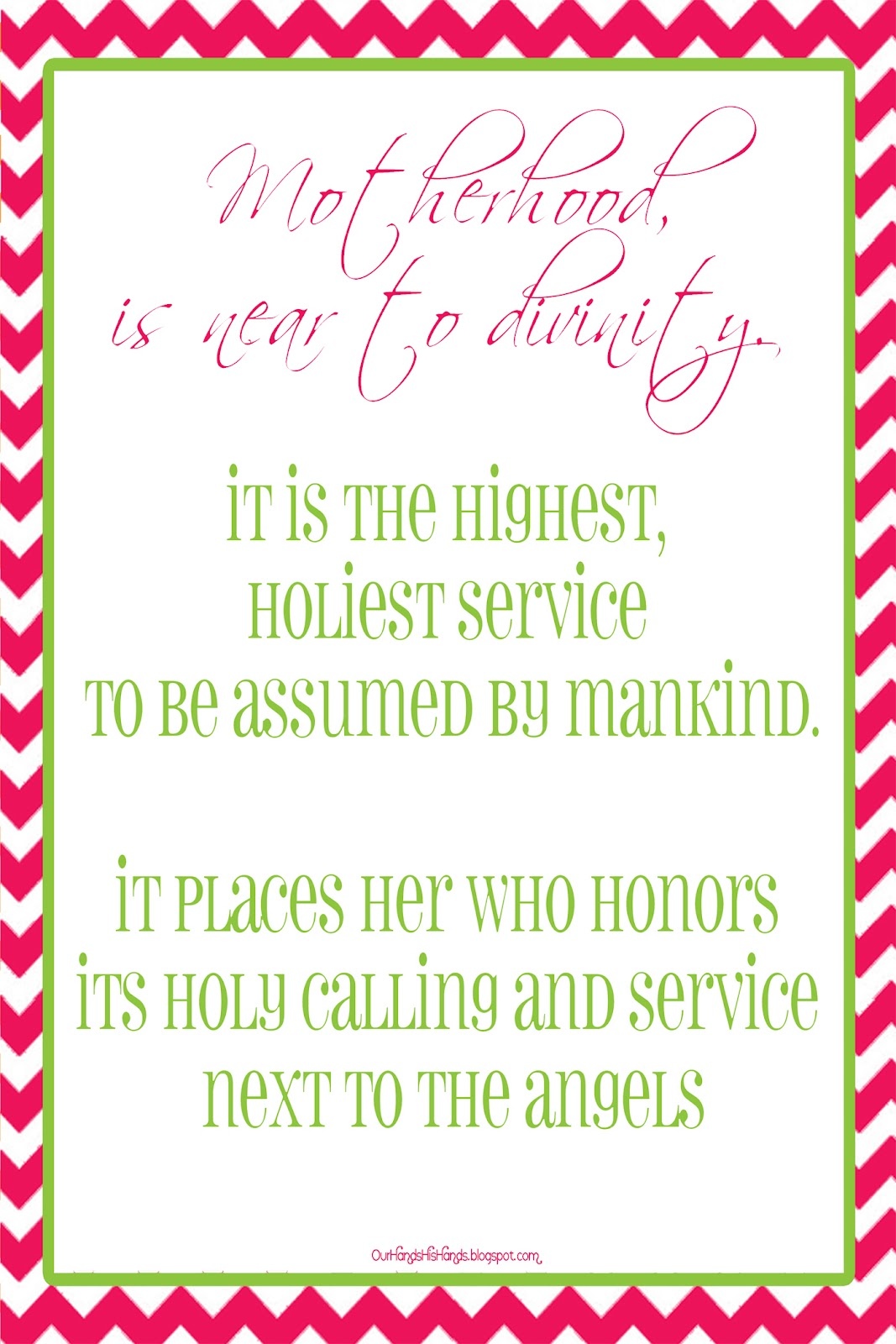
Is this what I will be doing for the rest of my life? Is this all there is to motherhood? Two questions every stay at home mother has asked herself at some point in time. I am blessed to have a wonderful godly husband who graciously reminds me how important my role/call is.
When you are almost 8 months pregnant & spend your days wrangling 3 very active toddlers along with the responsibility of maintaining a home that doesn’t look like toys r us ( and 8 loads of laundry) puked in your living room, the thought seems inevitable.
When you believe all your do is cook, change diapers, clean, organize, wipe food off little faces, entertain, etc every single day it becomes very difficult to navigate through those feelings and step back to capture the big picture. These are all small things. They may not seem small at the moment especially when our entire existence revolves around the needs of those God has entrusted to us. But trust me when I say the house work we do everyday does not even begin to define motherhood as a whole.
What then? What is motherhood about? What is the purpose of motherhood?
Allow me to suggest to you that motherhood is a holy calling. Mary, the mother of the Savior was given the greatest role of influence a woman can be entrusted with; nurturing a precious life into adulthood. Teaching them to transfer their dependency from you to their Savior.
In order to understand motherhood from a biblical perspective, we first need to understand what it was designed to accomplish. God blesses us with children that we may raise godly offspring for His glory. That is the entire purpose/ mission of motherhood.
The mundane everyday challenges and activities sure have a way of choking the truth and shifting our focus from the eternal to the temporal. As mothers our call is so enormous, we simply can not afford to be in the word renewing our minds daily. We can not afford not to draw near to God because only He can equip us to be the mothers He has called to be. Or mission will suffer significantly if we claim self sufficiency.
There is no greater call than to raise the next generation, a generation sold out to Christ. A generation that is so radically contrary to this world people will clearly see Christ in and through them. No words needed. Their lives may be the only bible some people may ever read. 🙂
We accomplish this by example. Our children are constantly watching us. What message are we sending them? Is it, I am doing this because I’m supposed to but I’m not content in my role/ call? Do you send the message that there are a million things way more important you can be spending your time, creativity, resources, talents by your lack of patience? Do they honestly think they are a gift from God to be cherished by your loving/ joyful demeanor? After all you are their main instructor on all things “life”.
Sweet friends if this isn’t our heart attitude we need to go back to understanding biblical motherhood. The amazing responsibility God places in the mother to train/ raise these precious little ones to love and honor God and to equip them to embrace the call and purpose God has for their lives.
Motherhood isn’t about dishes, laundry, diapers, dinners and endless arts and crafts projects. It is about us being content right where we are because this is the season in life God has decreed for us. Embrace it instead of trying to hurry through it. Be present instead of wishing the time will pass quickly because the you will be able to enjoy the next season much more. This is a lie. A lie designed to rob mothers of the present time and wonderful memories that could be created.
Wishing you were in a different season in life, wanting more than God decided you need, being mentally absent from precious moments that could be used as teaching moments is how the enemy robs us from the true joy of mothering on purpose.
The same lie that Eve bought into in the garden, we are buying into today. God is holding out on us by calling us to give up everything we think we want to pursue for everything He has designed us to accomplish. We believed the lie that we will be fulfilled by doing something with “real” significance because we first bought the lie that motherhood is just about dishes, laundry and mundane housework. The lie that only women who couldn’t do any better become homemakers ( more like life coaches to a handful of little people).
It is time to replace that lie with the truth.
Motherhood is a high and holy calling that is you choose to embrace with the right heart attitude will impact many generations to come…all for the glory of God.
When women as a society started to believe the lie during the feminist movement, and decided to go venture into the world to find self fulfillment the very fabric of the family in this country was torn. Now the lie about the purpose of motherhood is creeping into our churches. More professing christian mothers are dropping their little ones at a day care facility in order to pursue their “dreams” and in hope of finding some self fulfillment or purpose. Little do they know that is a never ending road, simply unattainable because God designed a mother to embrace motherhood and train/ disciple the next generation.
The call was to die to self. As we do this daily as serve our families as unto the Lord, He will bless us with joy abundantly and fulfillment…knowing we are making a huge impact for the kingdom because motherhood is kingdom work!
“There is no doubt about what a woman’s role is, there’s no doubt what a man’s role is. What has God designed for a woman? Verse 4, “To love their husbands, to love their children, to be sensible, pure, workers at home, kind, being subject to their own husbands that the Word of God may not be dishonored.” That’s very clear.
You can get in a lot of trouble by suggesting that kind of stuff. Try standing up in this culture and saying, “Women, you’re commanded to love your husband and to love your children and to work at home and to be subject to your husband.” You’ll get screamed down. I mean, you can be in deep trouble just reading that let alone commenting on it.” John MacArthur
“She is to be a home keeper, that’s the sphere of her responsibility, that’s her place of employment, that’s where she should pour her life. For a mother to get a job outside the home and send the children to some kind of daycare place is to shirk her God-given responsibility. It also is failure to understand that her husband is to be the provider, as Ephesians 5 makes very clear. Even if you wanted to work outside the home to pay for your children to go to a Christian school, you made a big mistake. Better that you should stay in the home and raise your own children to be godly then to pass it on to somebody else.” John MacArthur
Further suggested reading:
The Guilt Trip of Motherhood.
http://lightnercrew.com/2013/05/08/the-guilt-trip-of-motherhood-guilt-free-zone/
A Stay at home mom’s identity crisis.
http://lightnercrew.com/2011/11/20/a-stay-at-home-moms-identity-crisis/
Beauty & the Christian woman…Reclaiming Beauty for God.
For people of faith, a fuller understanding of beauty is that it always points us back towards God’s self and God’s goodness. If we Christians believe Scripture, then even though we recognize that all creation mirrors the beauty of God, we most fully recognize God through the person of Jesus Christ. To look for God is first to look to the Word that bears witness to the Triune God, and then to match up the witness of the illuminating Word with the Spirit’s movement in the world. Following this trajectory presumes that beauty is that which reflects the life of Christ.

Such reasoning offers a whole new landscape on which to spot and cultivate the multiple forms that beauty takes, including what we do with our bodies, and how we use our hands and minds to nurture the flourishing of those in and out of our communities. Consequently, a historical litany of the most beautiful women would include Harriet Tubman, Wangari Muta Maathai, and the numerous Argentinean women known asGrandmothers of La Plaza de Mayo. A God-centered hunger for beauty is most fully satisfied when we pattern our lives after what we know of God’s character through Christ. And this is by no means to suggest a Marcion reading, that we know God only through the New Testament. Rather, as Lutheran theologian Dietrich Bonhoefferposited so beautifully, we know God and his covenant story with humanity only by starting in the middle of God’s story, with Christ.
Our culture’s sinful emphasis on physical beauty doesn’t make it bad. As one naturally motivated and affected by aesthetics, I won’t deny the power of the human form in the peoples and cultures that reveal God’s incomprehensible, holy imagination. As a woman convicted that cultivating internal beauty both honors God and provides a way of living into God’s best for us, I also hold that women, Christian or not, can and should delight in the beauty of their human form.
Physical attributes of beauty are also a segment of beauty from the God-centered perspective. Our bodies are works of divine art, in all their shapes and sizes and various abilities or disabilities. It is always an act of faithfulness to delight in that which God delights, and I believe that God delights in what God creates. How one accentuates the beauty of the human form is another topic altogether, full of subjective arguments. But there is nothing inherently wrong with minding how we look and expressing our attempts, albeit at times quite fallen, to layer our multifaceted ideas of beauty upon that which is already beautiful. I am both playfully and sincerely grateful that I have the luxury to dwell on what I believe is most flattering to my human form, what dresses, occasional shade of lip gloss, or flimsy scarf makes me feel beautiful.
But while I delight in seeking to be beautiful on the inside and on the outside, I don’t hang my existential coat on this body. The grace of Christ and the power of the Spirit help me cultivate the former and hold the latter loosely. There is no doubt that Kanazawa was on to something in that beauty deserves attention. But that attention should ultimately point us back to God, “beauty’s self and beauty’s giver.”
By: Enuma Okoro, holds a Master in Divinity from Duke University.

A New Look at How to Glorify God in Your Body
What is beauty?
Some say beauty fits in a size 0. Some say beauty comes in all shapes and sizes. Some say beauty is only skin deep. Some say beauty is only a quality of the heart. Some say beauty is truth. Some say beauty is a lie. Some say beauty is in the eye of the beholder. Some say beauty is as beauty does. Some say Elizabeth Taylor and Grace Kelly are beautiful. Some say everyone is beautiful. Some say beauty is divine. Some say beauty is corrupting.
From all this confusion, one idea emerges clearly: The world knows beauty matters. They talk a lot about it, write poetry and paint paintings celebrating it, and spend $160 billion dollars a year on it. But what’s equally clear is that they don’t know what it is. The question is: Do we?
Today’s young Christian women have grown up in the most image-obsessed generation in history, a generation that worships some of the most twisted ideals of beauty the world has ever seen. But whether we love them or hate them… they tend to shape our own perceptions of what beauty is. Some of us accept its ideals, and struggle to fit into its mold – others of us are repulsed by it, concluding that physical beauty itself is immodest, worldly, and unspiritual, and reject the realm of beautification completely. But when all we’ve ever seen is the counterfeit the world offers, we can sometimes forget that the world did not create beauty – God did. And though we all know the world has a lot to say about image, we sometimes don’t realize how much God does too.

It’s time to reclaim beauty. For thousands of years, believers, pagans, Gnostics, Humanists, Neo-Platonists, iconoclasts, and creators of culture have battled over this critical turf called “beauty.” Today, we have only to look at who designs the fashions, markets the beauty icons, rules the red carpet, adorns magazine covers, crowns Miss America, and designs clothes-and-makeup advertisements, to know who is currently holding the turf.
It’s time to take beauty back. When faced with an industry that runs on photoshop airbrushing, plastic surgery, starvation diets, grotesque catwalk styles, and billions of squandered dollars, our response can no longer be, “Beauty is not for us.” It’s time for our response to be, “Get your flag out of our ground.” It’s time for us to be a light in a culture that uses beauty as a weapon against God. It’s time for God’s ambassadors to make His principles – such as modesty and femininity – look as beautiful as they really are. It’s time for us to show the world: Ugliness is not beauty. Emaciation is not beauty. Androgyny is not beauty. Immodesty is not beauty. Unnatural distortion is not beauty. From Genesis to Revelation, God paints a different picture of the inner and outer beauty of a woman, and it’s time to show the world what it really looks like – one soul, one body, one face, one closet at a time.
A Webinar on Reclaiming Beauty
with Anna Sofia and Elizabeth Botkin

This fall, the authors of So Much More and It’s (Not That) Complicated and producers of “Return of the Daughters” are launching an intensely practical, image-rich, 7-week webinar on the meaning and cultivation of beauty from the inside out. Join sisters Anna Sofia and Elizabeth Botkin as they dive into Scripture for the answers to an issue of great importance and frustration to young women: personal image.
Is it OK to look pretty? Wear makeup and jewelry? Put effort into my clothes? Take care of my body? Do I have to care about how I look? Where can I find modest, classy clothes without spending a fortune? What should my attitude be toward the latest fashions? How do I figure out what looks good on me? What is appropriate to wear when? What in the world do I do with my hair?
“Reclaiming Beauty: A New Look at How to Glorify God in Your Body” will cover topics ranging from such practical issues as skincare, fitness, posture, voice, modesty, home-made beauty products, and color analysis… to subjects as penetrating as personal identity, insecurity, comparisons, worldliness, vanity, idolatry, our attitude toward others, and the state of our hearts before the Lord.
Discover:
- What it means to represent the Lord as His ambassadors to the world
- Where true beauty starts
- What the Bible says about beautification and adornment
- How we should respond to the world’s idea of beauty
- The history and philosophy behind the most popular garments
- The proper priority-level of beauty in the Christian’s life
- The biblical relationship between the physical and the spiritual
- What it means to be separate from the world
- What we can learn from the beauty industry
- What the beauty industry has gotten wrong
Get practical tips on:
- Clothing yourself better for a lot less money
- Making modesty and femininity look excellent instead of frumpy
- Making off-the-rack clothes modest
- Putting together great outfits with what you already had in your closet
- Using makeup tastefully
- Giving sloppy garments new life with minimum alterations
- Cultivating taste and style
- Getting out of a fashion rut
- Creating a minimum-time-and-effort plan for looking nice every day
A Webinar That’s Not Just Skin Deep
Webinar sessions will run every Tuesday evening, 7-8 PM Central Time, from September 25 to November 13 (excluding October 30). The seven sessions include:
#1. What God Says About Beauty and Beautification
The Good, the Bad, and the Ugly
#2: What Style Is Your Heart, Mind, and Soul?
Pardon Me, Ma’am, But Your True Identity is Showing
#3. Getting Your Temple in Order
The Physical Foundations of Beauty
#4. Fearfully and Wonderfully Made
How to Work with the Build, Coloring, and Natural Beauty God Gave You
#5: Putting Things Together
Composition, Style, Occasion, Accessories
#6: Acquiring New Pieces (and Revitalizing Old Ones)
How to Get What You Need with Minimum Time, Money, and Fuss
#7: The Focal Point
Being a Good Steward of Your Face and Hair
The webinar registration fee is $44 per family. It is recommended for young women 12 and up, although parents are encouraged to listen with their daughters. Visit http://westernconservatory.com/reclaiming-beauty-webinar
Starting out as aesthetic ascetics and determined frumps who were clueless about beauty and fashion, Anna Sofia and Elizabeth have had to build their understanding of beauty from the biblical foundation up (a work still in progress). They have no beauty certifications whatsoever, though they do have experience dressing for everything from speaking engagements to political events to concert harp performances to good old dirty work around the farm, and each get everything they need (clothes, shoes, hair care, accessories, cosmetics, etc.) for around $130 a year. They’re also interested in reclaiming the biblical family, film, art, music, and politics, and work with their family’s ministry, Western Conservatory of the Arts and Sciences.
God’s Grace is enough!
Wholly yours by David Crowder Band…
You are everything that is bright and clean
And You’re covering me with Your majesty
And the truest sign of grace was this
From wounded hands redemption fell down
Liberating man
You are holy, holy, holy
All heaven cries “Holy, holy God”
You are holy, holy, holy
I want to be holy like You are
But the harder I try the more clearly can I feel
The depth of our fall and the weight of it all
And so this might could be the most impossible thing
Your grandness in me making me clean
Glory, hallelujah
Glory, glory, hallelujah
So here I am, all of me
Finally everything
Wholly, wholly, wholly
I am wholly, wholly
I am wholly, wholly, wholly
Yours
I am full of earth and dirt and you are…
This song displays Gods grace. Grace that even though we are filthy sinners and deserve flames He not only calls us to repentance but also forgives us for being so wicked at heart. Also the sense of conviction in the bridge displays Gods grace further in that we are mere sinners and so undeserving of Gods love and sometimes it seems just so impossible that we could be loved so much. Not that it is impossible, that’s just how one would feel when he feels convicted of his own sin and recognizes how graceful God really is…
The Sufficiency of God’s Grace by Dr. John MacArthur. http://www.gty.org/resources/sermons/80-72/The-Sufficiency-of-Gods-Grace









 Beautiful By Laire Lightner
You must be logged in to post a comment.